How to Stop Puppy Biting
Puppy biting is normal play and exploring, and most puppies mouth far less once their adult teeth are in, around 6 months. To reduce it, stop play when teeth touch skin, offer a toy instead, prevent overtiredness with naps, and reward calm behavior. Never hit or scold. Expect steady progress over weeks, not days.
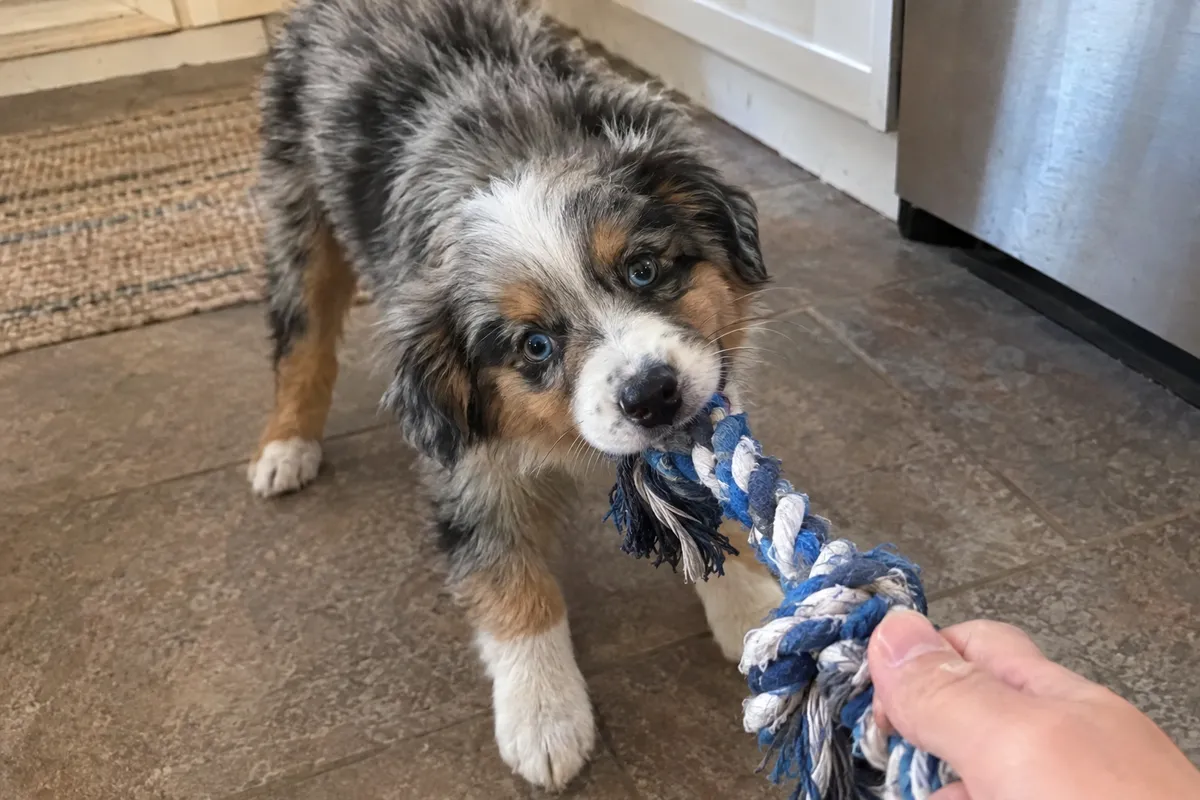
What you need
- Long tug toys and rope toys, so your hand stays away from teeth
- Safe chews sized for your puppy, in every room
- A pen, crate or baby gate for calm breaks
- Small treats for rewarding calm behavior
Bite inhibition: Bite inhibition is a dog's learned control over how hard it bites, usually learned in puppyhood through play.
Redirecting: Redirecting means swapping the thing your puppy is biting, like your hand, for something it's allowed to bite, like a toy.
Time-out: In puppy training, a time-out is a short pause of 10 to 60 seconds when play and attention stop, so your puppy learns that biting ends the fun.
Step by step
Set up your home first
Put toys within reach in every room and keep one in your pocket. Use a pen or baby gates so your puppy can't ambush ankles when you can't watch. If you're always reaching for a toy and never finding one, you're not ready yet.
Redirect before teeth land
Learn your puppy's wind-up: a play bow, a fixed stare at your hands, zooming. Offer a long tug toy right then, so your hand is far from its mouth. Praise when it grabs the toy. The ASPCA recommends tug and fetch over wrestling with hands.
Stop play when bites get hard
If your puppy bites hard, say "Ouch" in a short, calm voice, pull your hands in, and go still for 10 to 20 seconds. Then go back to gentle play. Some puppies get more excited by the noise. For them, skip the "Ouch" and just stop.
Use a short time-out if biting continues
If biting starts again within a minute, calmly step over a baby gate, or put your puppy in its pen with a chew, for 30 to 60 seconds. No scolding. The time-out is a break, not a punishment. Then try calm play again.
Ask for gentler and gentler mouths
Once hard bites are rare, stop play for softer bites too. Over a few weeks, stop for any teeth on skin. The ASPCA describes this as gradually asking for gentler mouthing until your puppy barely uses any pressure.
Teach a calm way to ask
Ask for a sit before play, before petting and before you pick your puppy up. Reward the sit with a toy, a treat or your attention. A puppy that has learned to sit for attention has a better option than grabbing your sleeve.
Feed during petting and handling
If your puppy mouths you when you pet it, feed small treats from one hand while you pet slowly with the other. Keep it short. Your puppy learns that hands bring good things and that calm is rewarded.
Timing
React the instant teeth touch skin, not after the third bite. Stop play and go still for 10 to 20 seconds, then go back to calm play. If biting starts again, step away for 30 to 60 seconds. Reward calm moments within 1 to 2 seconds. Keep play bouts to a few minutes, and plan naps, because overtired puppies bite more.
Common mistakes
- Hitting, tapping the nose or holding the mouth shut. These teach your puppy to fear hands, and some puppies bite harder in response. AVSAB advises against aversive methods for any training.
- Scruffing, pinning or "biting back". These are based on outdated dominance ideas, and they risk making your puppy afraid of you. They don't teach your puppy what to do instead.
- Yelling. A loud reaction can make the game more exciting, or frighten your puppy. Calmly going still and quiet works better.
- Jerking your hands away. Fast-moving hands and feet look like prey. Go still instead. The ASPCA suggests letting your hand go limp rather than pulling it back.
- Using hands as toys. Wiggling fingers or wrestling teaches your puppy that hands are for biting. Put a toy between you and the teeth every time.
- A puppy with no naps. Many "biting problems" are overtired puppies, often in the evening. A puppy that has been up and playing for a long time needs a quiet nap, not more play.
- Every family member doing something different. If one person wrestles and another does time-outs, your puppy can't learn the rule. Agree on what everyone does when teeth touch skin.
Troubleshooting
| If your dog… | Try this |
|---|---|
| If your puppy bites harder when you say "Ouch" | The noise is exciting it. Skip the yelp. Stand up, fold your arms, look away, and step out of reach for 10 to 20 seconds. |
| If your puppy bites your ankles when you walk | Stop walking and go still, then offer a tug toy. Carry one with you. AKC suggests holding a treat by your leg as you walk, so your puppy learns to walk beside you instead of pouncing. |
| If your puppy goes wild every evening | This is often overtiredness. Plan a quiet nap in the pen or crate with a chew before that time of day, and keep evening play calm and short. |
| If your puppy bites when you pick it up or brush it | It may not like being handled yet. Feed small treats during very short handling, and build up slowly. If your puppy goes stiff, freezes or growls, talk to your vet and a qualified behavior professional. |
| If your puppy grabs your clothes and pulls | Go still, so your clothes stop being a fun tug toy. Then offer a real tug toy. If your puppy keeps grabbing, give it a short time-out. |
| If your puppy bites the kids | Children running and squealing set off chasing and biting. Supervise all play. Teach children to stop, fold their arms and look away when the puppy mouths. Use a gate so the puppy and kids can take breaks from each other. |
By age
- Puppy (8 to 16 weeks)
- Mouthing is at its most frequent. Your puppy is learning bite inhibition now. Play with other vaccinated puppies helps, and AVSAB says puppy classes can start at 7 to 8 weeks with at least one set of vaccines.
- 4 to 6 months (teething)
- Adult teeth are coming in and the urge to chew is strong. Offer plenty of chews, and rotate toys so they stay interesting.
- Adolescent (about 6 to 18 months)
- Mouthing should be much lower by now. If your dog is still biting hard and often at 6 months, get help from a trainer or behavior specialist.
- Adult dogs
- Hard mouthing in an adult dog isn't a puppy phase. Start with a vet check for pain, then work with a certified trainer or behaviorist.
What to work on next
Once hard bites are rare, put that energy into short training sessions. Teaching sit gives your puppy a calm way to ask for attention, and the puppy sit guide has a plan by age. To make your marks clearer, read the guide to marker training.
How Sit AI helps
Sit AI won't fix biting on its own. It helps you teach your puppy something better to do. Run short sit sessions before meals, play and petting; the app tells you when to treat and tracks progress. A puppy that has learned to sit for attention has a calmer way to ask for it.
When to get help
Mouthing in play is normal. It's not normal play when biting comes with a stiff, frozen body, a hard stare, or growling with lips pulled back, or when your puppy bites out of fear, such as when cornered or handled. The ASPCA notes these can signal future aggression. Also get help if biting is still hard and frequent at 6 months, or breaks skin often. Look for a veterinary behaviorist (DACVB), a certified applied animal behaviorist (CAAB), or a certified trainer with experience in fear and aggression. Ask your vet to check for pain too.
FAQ
When do puppies stop biting?
Most puppies mouth much less once their adult teeth are in, around 6 months, especially if they've been taught bite inhibition. AKC suggests talking to an experienced trainer or behavior specialist if biting hasn't eased by 6 months.
Is my puppy's biting aggression?
Usually not. Play biting with a loose, wiggly body is normal. Warning signs are a stiff body, freezing, a hard stare, or biting when scared or handled. If you see those, talk to your vet and a qualified behavior professional.
Should I yelp when my puppy bites?
It works for some puppies and backfires for others. A short "Ouch" and stopping play can teach that hard bites end the fun. If your puppy gets more excited, skip the noise and calmly end play instead.
Do taste deterrent sprays help with puppy biting?
The ASPCA lists taste deterrents as an option if time-outs aren't working, used for at least two weeks while you also reward gentle play. Use one alongside redirection and time-outs, not instead of them.