How to Teach a Dog to Stay
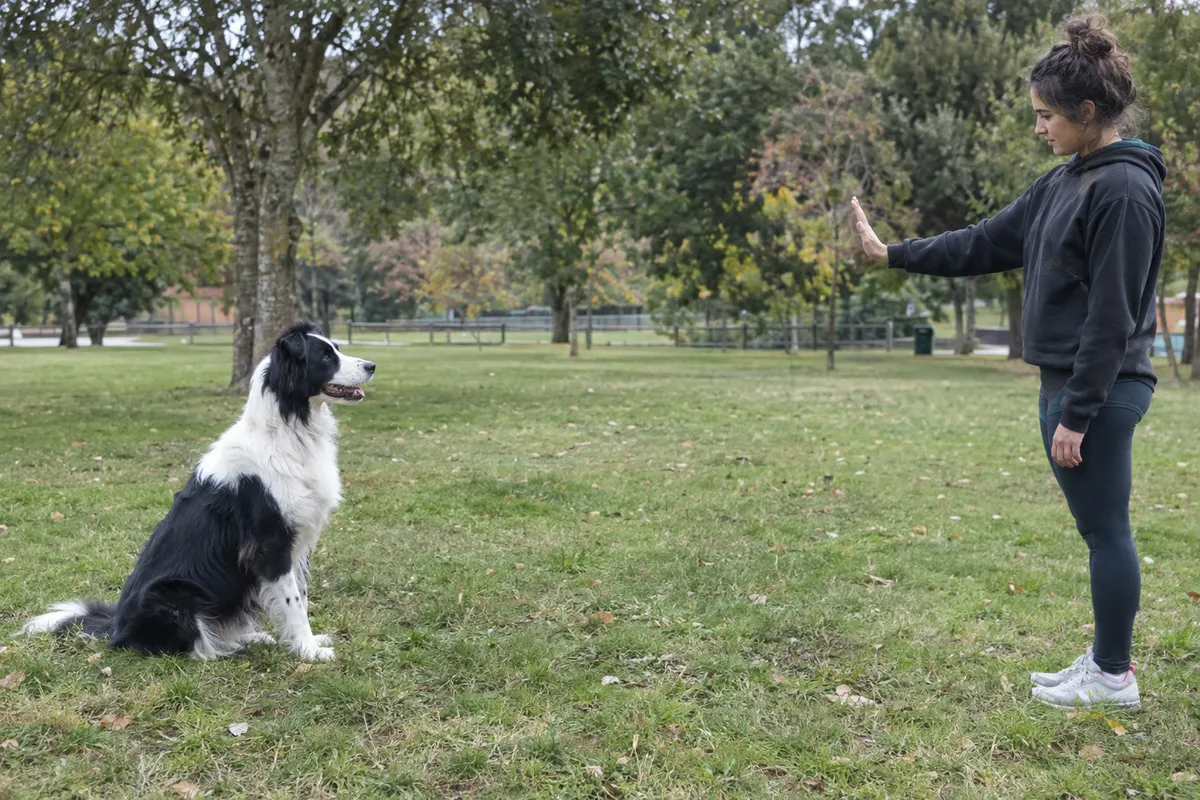
Ask for a sit, show a flat palm, wait 1 second, then mark and feed while your dog is still sitting. End with a release word. Add a few seconds at a time, then distance, then distractions, changing only one at a time. Most dogs can hold a 30-second stay at home after 2 to 4 weeks of short sessions.
What you need
- A dog that already sits or lies down on cue
- A release word you don't use in everyday talk, like "Free"
- Small treats, enough to feed several during each stay
- A quiet room to start, and a leash for practice outdoors
Release word: A release word is a cue, like "Free" or "Break", that tells your dog the stay is over and it may move.
The 3 Ds: The 3 Ds of stay training are duration, distance and distraction, and you raise only one of them at a time.
Step by step
Teach the release word first
With your dog sitting, say "Free" and toss a treat a few feet away so it gets up to chase it. Do 5 to 10 reps. Your dog learns that the word means it can move. It's working when your dog starts to get up as soon as you say it.
Ask for a 1-second stay
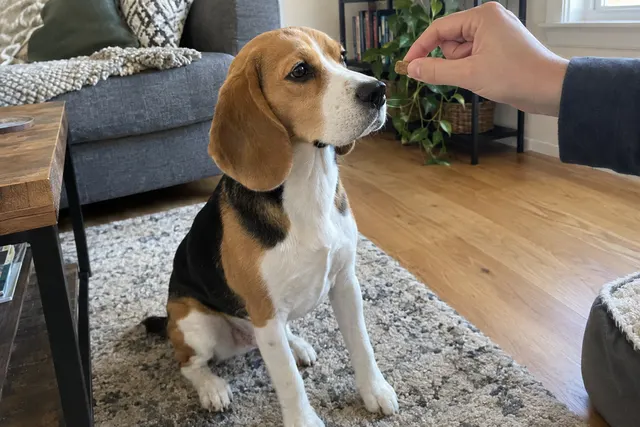
Ask for a sit. Show a flat palm toward your dog's face, count one second, then mark and feed while it's still sitting. Say your release word and toss a treat. Repeat 5 times.
Build time a few seconds at a time
Go to 2 seconds, then 3, then 5, mixing in some easy short ones. Once you pass about 10 seconds, feed a treat every few seconds during the stay. Aim for 30 seconds with you standing right in front. This usually takes several sessions.
Add distance one step at a time
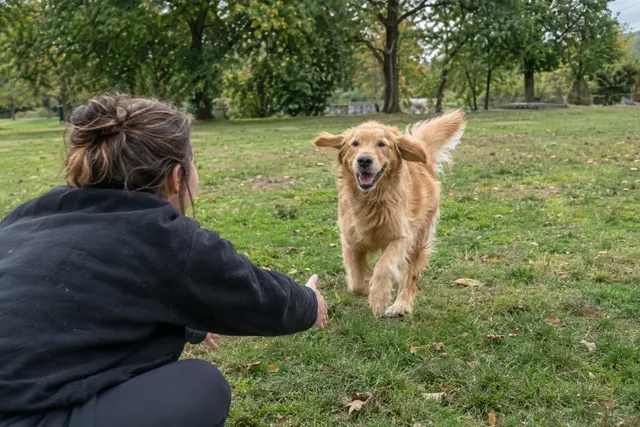
Drop the time back to 5 seconds. Take one step back, step back in, then mark, feed and release. Then try two steps. Always walk back to your dog to reward, so it never learns that coming to you ends the stay. Build up to the edge of the room.
Add small distractions
Lower the time and distance again. While your dog stays, shift your weight, then clap once, then drop a glove, then bounce a ball. If your dog breaks twice in a row, make the distraction smaller.
Practice in new places
Move to another room, then the yard, then a quiet part of a park, on leash. Start each new place at 5 seconds and one step away. Your dog's stay is reliable when it holds 30 seconds with mild distractions in 3 different places.
Timing
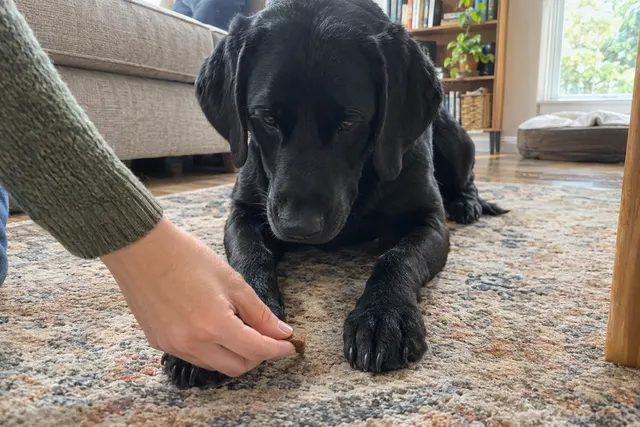
In stay training you mark holding still, not moving. Mark and feed while your dog is still in position, every few seconds at first, and deliver within 1 to 2 seconds of the mark. Release before your dog breaks, not after. Keep sessions to 3 to 5 minutes, 2 or 3 times a day.
Common mistakes
- Raising two Ds at once. Walking 10 steps away for 30 seconds is two jumps in difficulty at once. Your dog breaks, and it practices failing. Raise one thing, and lower the others while you do.
- Calling your dog out of a stay. If stays often end with "Come", your dog starts to guess and creep toward you. Walk back and release. Practice come as a separate exercise.
- Paying for the release, not the stay. If the best treat comes after "Free", your dog learns to wait for the release, not to enjoy staying. Feed the good stuff during the stay. AKC makes the same point.
- Using "okay" as the release word. You say "okay" all day, and your dog will hear it as a release by accident. Pick a word you don't use in conversation.
- Scolding a break. A sharp "No" or roughly putting your dog back in place makes stay stressful. Calmly reset, and make the next rep easier.
- Forgetting to release. If you walk off and never release, your dog decides when the stay ends. End every stay with your release word.
Troubleshooting
| If your dog… | Try this |
|---|---|
| If your dog breaks as soon as you step back | Your movement is the problem. First lean back without moving your feet, then try a half step. Feed while you're still close, and add distance slowly. |
| If your dog creeps toward you | You're too far away or the stay is too long. Shorten both, and walk back to your dog to reward. If you've been calling it out of stays, stop for now. |
| If your dog lies down during a sit-stay | A long sit can be tiring. For stays longer than about a minute, teach a down-stay instead, which is easier to hold. Keep sit-stays short. |
| If your dog stays in the kitchen but not in the park | A new place is a new lesson. Start over at 5 seconds and one step away, with better treats, and build up again. It goes faster each time. |
| If your dog breaks when you turn your back | Turning around is a distraction of its own. Turn your head, then your shoulders, then turn fully away for one second, and reward each step. |
| If your dog whines, pants or shakes during a stay | These are signs of stress. Stay closer, shorten the stay, and feed more often. If it keeps happening when you move away, see the section on getting help below. |
By age
- Puppy (8 to 16 weeks)
- Teach the release word and stays of 1 to 5 seconds. A few seconds of stillness is a win at this age. Keep sessions to 1 to 3 minutes.
- Adolescent (about 6 to 18 months)
- Self-control dips at this age. Keep stays short, feed often, and practice at real moments, like the door before a walk.
- Adult or rescue
- Adult dogs usually build time quickly. Distance is the usual sticking point, especially for a dog that likes to stay close to you. Go one step at a time.
- Senior
- Long sit-stays can be hard on older hips. Use a down-stay on a soft mat, and keep stays short.
What to work on next
When your dog holds a 30-second stay in 3 places, use it at real moments: at the open front door, before the food bowl, while you put your shoes on. Then teach come as its own exercise. If sit or down is still shaky, go back to those guides first, because a stay is only as good as the position it starts from.
How Sit AI helps
Stay is built on a solid sit. Sit AI watches your dog, tells you when to reward, and shows you how reliable the sit is before you add time and distance. Once your dog's sit is reliable, the app tells you it's time to start stays.
When to get help
If your dog panics when you move away, drools, pants hard or tries to follow you even in short stays, this may be more than a training gap. Distress about being apart from you is worth discussing with your vet or a certified behaviorist. Also see your vet if your dog can no longer hold a sit or down it used to hold, since discomfort is a common cause.
FAQ
What is a good release word for a dog?
A short word you don't use in everyday talk, like "Free", "Break" or "All done". AKC notes that "Okay" is common but easy to say by accident. Use the same word every time a stay ends.
Do I need to say "stay" at all?
Not necessarily. Many trainers teach that sit and down mean hold the position until released, so a separate stay word isn't needed. If you do use "Stay", say it once, and keep the same rule: only the release word ends it.
How long should a dog be able to stay?
For daily life, 30 seconds to a minute with you nearby covers most needs, like opening the front door or setting down a food bowl. Longer stays, several minutes in a down, take many weeks of practice in different places.
Why does my dog break the stay when I walk away?
Usually you added distance too fast, or kept the stay long while adding distance. Go back to a short stay and one step, and build up again. Walking back to your dog to reward also helps.