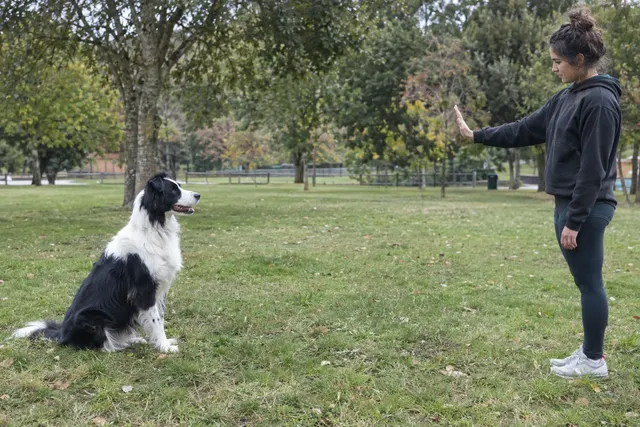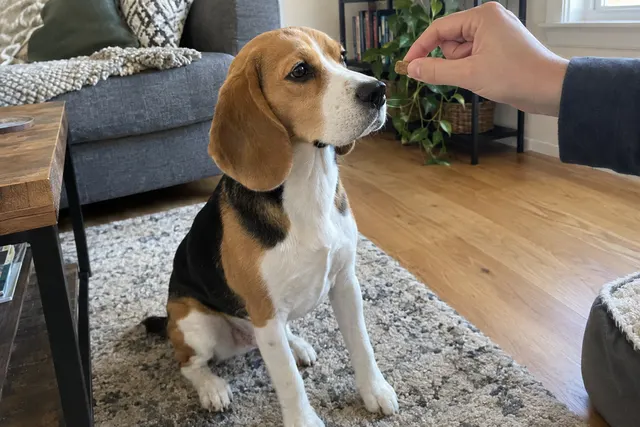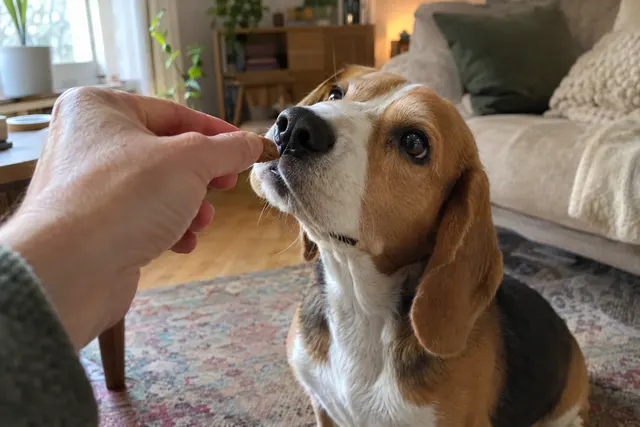
How to Teach a Dog to Come When Called
Make coming to you the best thing your dog does all day. Start indoors: say your dog's name and "Come" once in a happy voice, back up a few steps, and reward well when it reaches you. Add distance, then go outside on a long line, then add distractions. Recall at home takes weeks; outdoors, expect months.
What you need
- Your best treats, like small pieces of chicken or cheese
- A 15- to 20-foot long line and a harness for outdoor practice
- A helper for recall games
- A fresh cue word if your dog already ignores "Come"
Recall: Recall is your dog's response to a cue that means stop what you're doing and come straight to me.
Poisoned cue: A poisoned cue is a word your dog has learned to ignore or dislike, usually because it was repeated with no follow-through or was followed by something unpleasant.
Long line: A long line is a leash of 15 feet or more that gives your dog freedom outdoors while you keep a safe hold during recall training.
Step by step
Choose your word and make it great
If your dog already tunes out "Come", pick a new word like "Here". In the kitchen, say it once and feed 3 treats in a row. Do this 10 times. Your dog learns that this word always means something good.
Start at two steps
When your dog is close and not busy, say its name and the cue once, then take 2 quick steps back. When it reaches you, mark and feed 2 or 3 treats. Touch the collar gently while you feed, so being held stays pleasant. Do 5 to 10 reps.
Add distance inside
Call from across the room, then from another room. Play hide and seek: hide, call once, and celebrate when your dog finds you. If your dog doesn't come within 3 seconds, clap or crouch and move away instead of repeating the word.
Play recall games with a helper
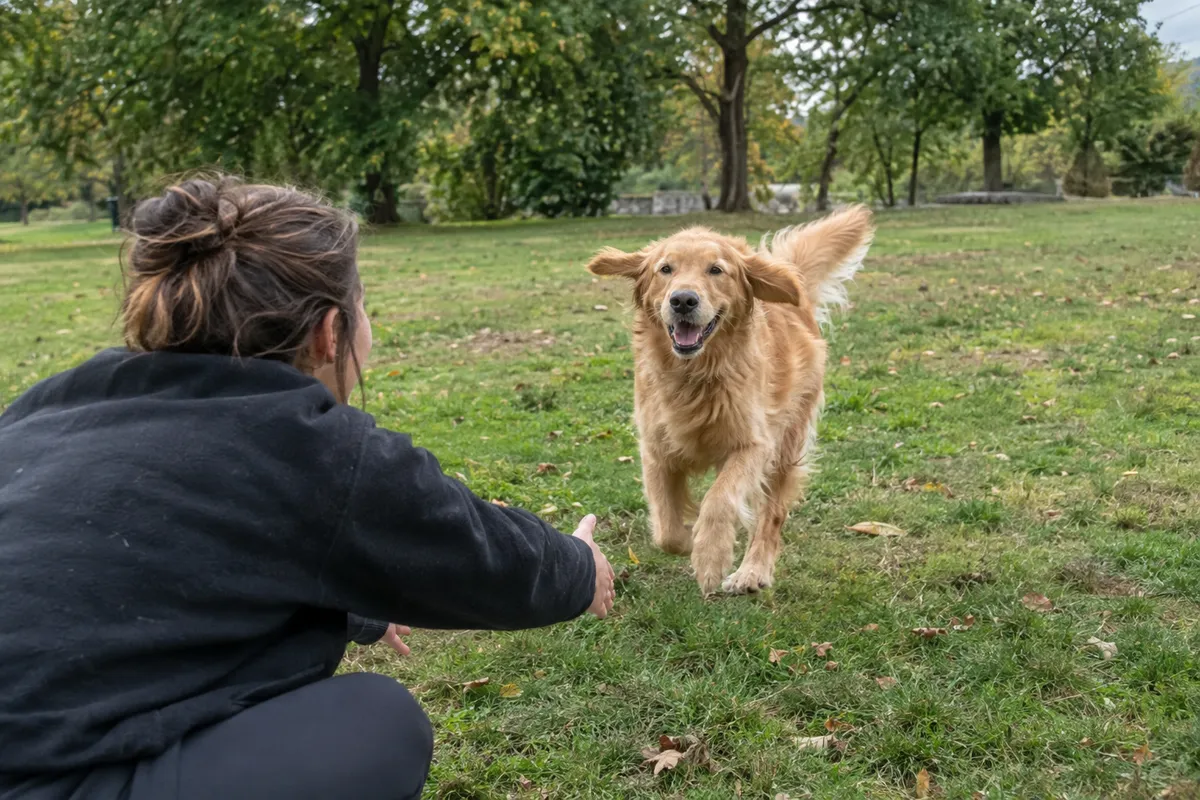
Stand a few yards apart and take turns calling your dog, each person rewarding when it arrives. Move farther apart as your dog gets faster. This game packs a lot of good recalls into a few minutes.
Go outside on a long line
In a quiet area, clip a 15- to 20-foot long line to a harness. Let your dog sniff, then call when it isn't deeply focused on something. If it doesn't respond, back away and use your voice. Don't reel it in. The line is there for safety, not to drag your dog to you.
Call away from fun, then send your dog back
During play or sniffing, call your dog, reward it, then say "Go play" and let it go back. This way, coming to you doesn't always mean the fun is over. AKC recommends the same approach.
Add distractions slowly
Practice near a toy on the ground, then with a person walking past, then with a dog far away. Keep the long line on until your dog comes on the first call 9 of 10 times in that setting. Off leash, start in safely fenced areas only.
Timing
Praise while your dog is running to you to keep it coming, then mark the moment it arrives and feed within 1 to 2 seconds. Give 2 or 3 treats one after another, not just one. Do 5 to 10 recalls in a 3- to 5-minute session, 2 or 3 sessions a day, and stop before your dog loses interest.
Common mistakes
- Calling only to end the fun. If "Come" always means leash on, leave the park, or go inside, your dog learns to avoid it. Call often for good things, and go and get your dog for the boring ones.
- Scolding a slow recall. Even if it took two minutes, reward your dog when it gets to you. If arriving means trouble, the next recall will be slower. AKC warns against punishing a slow recall.
- Repeating the cue. "Come, come, COME" teaches your dog that the word is background noise. Say it once, then make yourself interesting: crouch, clap, run away.
- Chasing your dog. Running after your dog turns recall into a game of keep-away. Run the other way instead. Most dogs will chase you.
- Going off leash too soon. One great recall in the backyard isn't proof. A dog that runs off and finds something fun has just practiced not coming back. Keep the long line on longer than you think you need to.
- Paying with boring rewards. A piece of kibble can't compete with a squirrel. Use your best food for recalls, and more of it than for any other behavior.
Troubleshooting
| If your dog… | Try this |
|---|---|
| If your dog looks at you, then goes back to sniffing | The distraction is too strong for the distance. Move closer, call when your dog is less absorbed, and use better treats. Then build distance back up. |
| If your dog comes but stops just out of reach | Your dog may have learned that arriving means being grabbed. Practice collar touches paired with treats at home, feed close to your body, and sometimes let your dog go right after the treat. |
| If your dog comes inside but not in the yard | The yard is a new place with new smells. Start over at a short distance in the yard, at quiet times, then build up again. |
| If your dog runs off when you unclip the leash | Go back to the long line for now. Don't chase. Call once in a happy voice and run the other way, and reward when it reaches you, however long it took. |
| If your dog only comes when it sees food | Keep treats in a pouch or pocket, out of sight, and don't show them before calling. Sometimes reward with a toy or a game too. |
| If your dog ignores you around other dogs | This is the hardest level of recall. Practice farther away from other dogs, where your dog can still respond. A group class can provide controlled practice with dogs around. |
By age
- Puppy (8 to 16 weeks)
- Young puppies tend to follow you. Use it: call often around the house and reward every arrival. Keep sessions to 1 to 3 minutes.
- Adolescent (about 6 to 18 months)
- Many dogs with a great puppy recall start ignoring it at this age. It's normal. Put the long line back on and make rewards bigger for a while.
- Adult or rescue
- You may not know what "Come" meant in your dog's past. Pick a new word and start at the first step. Use a long line outdoors until you've built a track record.
- Senior
- If an older dog stops coming, check its hearing and eyesight before you assume it's ignoring you. Teach a big hand signal, and keep distances short.
What to work on next
When your dog comes on the first call in the yard, ask for a sit when it arrives, so it doesn't grab the treat and run off again. The sit guide covers that. Once both are solid, combine recall with stay, and use the clicker timing guide to mark arrivals at the right instant.
How Sit AI helps
Sit AI doesn't track recalls. It helps with the finish: if you ask for a sit when your dog reaches you, and the phone can see that spot, the app coaches that sit and counts it. A dog that comes and sits in front of you is a recall you can rely on.
When to get help
If your dog bolts in fear and can't be called back, or seems to run from you in particular, work with a certified trainer or veterinary behaviorist. More recall practice won't fix fear. See your vet if your dog suddenly stops coming when called, especially an older dog. Hearing loss, vision loss or pain can look like ignoring you.
FAQ
Why won't my dog come when called?
Usually the cue was repeated with no follow-through, coming meant the fun was over, or the distraction is worth more than your reward. Start fresh with a new word, short distances and your best treats, and rebuild step by step.
Should I use a shock collar to teach recall?
No. AVSAB recommends reward-based methods for all training. In a 2020 University of Lincoln study, dogs trained with rewards responded to "Come" on the first command more often than dogs trained with e-collars, and the authors concluded an e-collar is unnecessary for recall.
When can I let my dog off leash?
When your dog comes on the first call about 9 of 10 times on a long line, in that kind of place, with real distractions. For many dogs that takes months. Start in safe, fenced areas, and follow local leash laws.
What should I do when my dog doesn't come?
Don't repeat the cue or chase. Make an interesting noise, crouch down, or run the other way. When your dog arrives, reward it anyway. Then make your next practice easier: shorter distance, fewer distractions.
Sources
- American Kennel Club: How to Train a Reliable Recall for Your Dog
- RSPCA: Train your dog to come when called
- China, Mills and Cooper (2020): Efficacy of Dog Training With and Without Remote Electronic Collars vs. a Focus on Positive Reinforcement, Frontiers in Veterinary Science
- AVSAB: Position Statement on Humane Dog Training (2021)