How to Teach a Dog to Lay Down
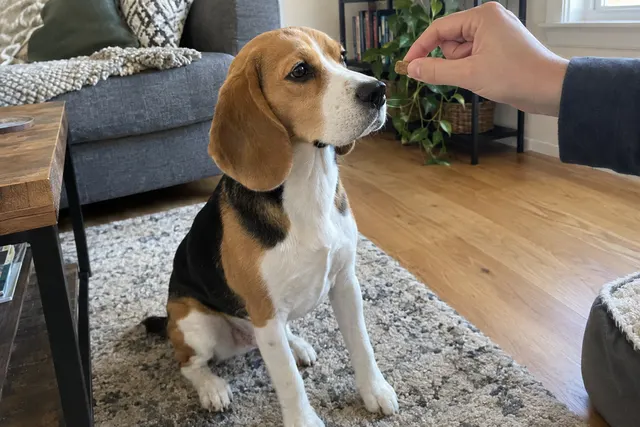
Ask for a sit, then move a treat from your dog's nose straight down to the floor between its paws, then slowly out a few inches. When both elbows touch the floor, mark and feed on the ground. Most dogs follow the lure within a few sessions and lie down on a word within 2 to 3 weeks.
What you need
- Small soft treats your dog loves
- A marker: a clicker or a word like "Yes"
- A mat, rug or dog bed to lie on
- A dog that already sits on cue, and has had a walk or play first
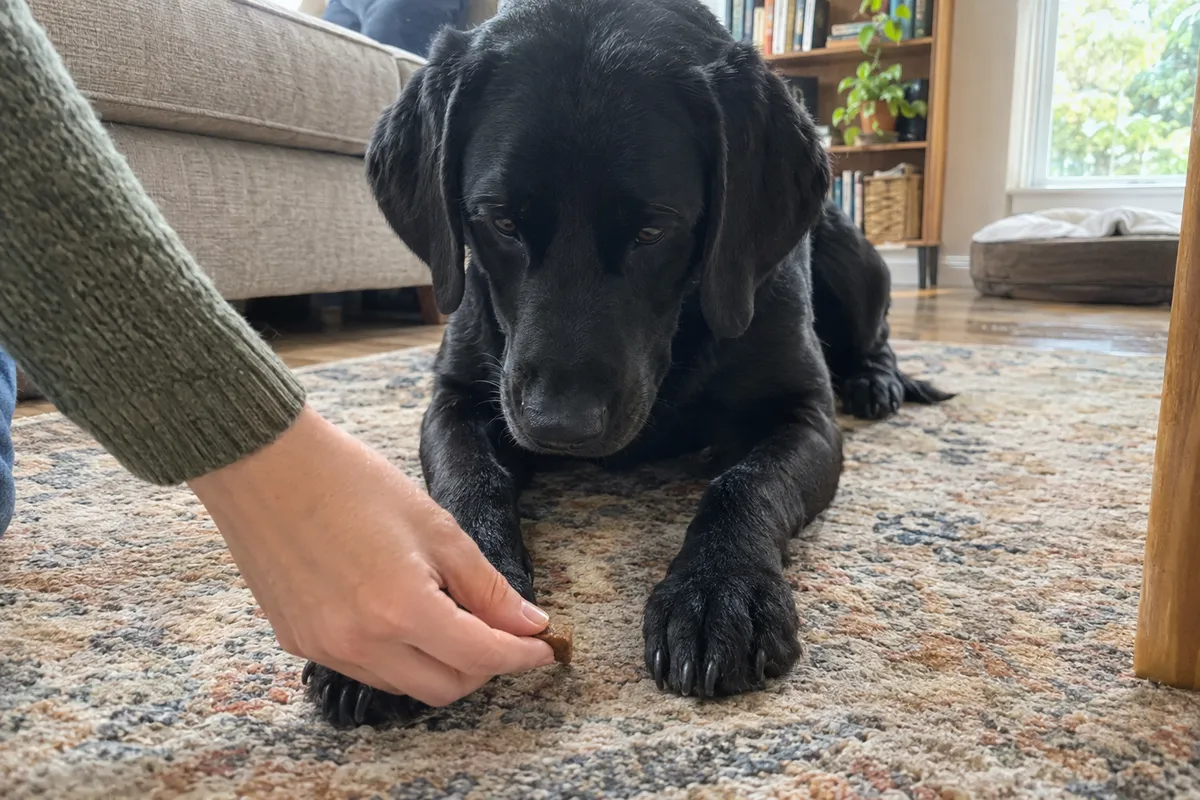
Sphinx down: A sphinx down is a down with both elbows and the chest on the floor and the hips square, not rolled onto one side.
Shaping: Shaping means rewarding small steps toward a behavior, like lowering the head, then bending the elbows, until the full behavior appears.
Push-up: A push-up is when a dog drops into a down and springs straight back up, usually because the treat came after it stood.
Step by step
Start from a sit, on a soft surface
Put a mat or rug down. Ask your dog to sit, and kneel or sit on the floor in front of it. Dogs lie down more willingly on a soft, non-slip surface, and more willingly still when they're a bit tired, so train after a walk.
Lure straight down
Hold a treat at the nose and lower it slowly, straight down to the floor just in front of the front paws. Take 2 to 3 seconds for the move. Most dogs follow with the nose and fold the front end. If the rear lifts, you moved forward too soon.
Slide it out a few inches
With the treat at the floor, slide it slowly away from the paws, 2 or 3 inches. The elbows drop as your dog stretches to follow. Mark the instant both elbows touch, then let your dog have the treat on the floor.
Feed in position, then release
Give 1 or 2 more treats while your dog is still down. Then say your release word, like "Free", and toss a treat so it gets up. This stops push-ups. Do 5 reps, and move on when your dog lies down 4 of 5 times.
Fade the lure into a hand signal
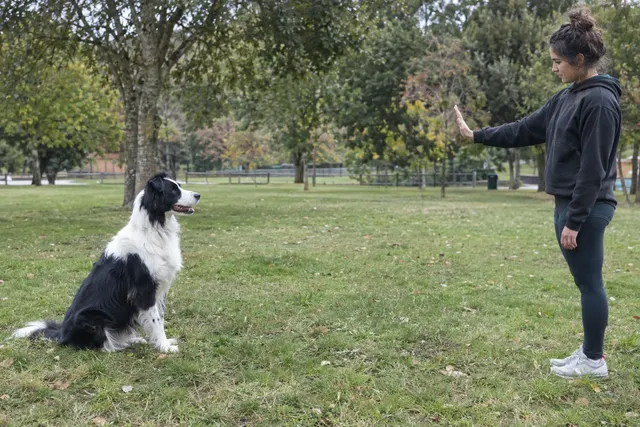
Make the same downward motion with an empty hand. Mark the down and pay from your other hand. Over a few sessions, make the motion smaller until you're pointing at the floor from a standing height. That point becomes your hand signal.
Add the word
Say "Down" once, pause one second, then give the hand signal. Over several sessions, wait 3 seconds after the word before you help. When your dog lies down on the word 8 of 10 times, start practicing in other rooms.
Ask from a stand, and in new places
Once down from a sit is solid, ask for it from a stand. Then practice in the yard, at a friend's house, and in a quiet corner of a park, with a mat. Expect to help with the hand signal again in each new place for 2 or 3 sessions.
Timing
Mark the instant both elbows touch the floor. Feed within 1 to 2 seconds and put the treat on the floor between the paws, so your dog stays low. Keep sessions to 3 to 5 minutes, 2 or 3 times a day. Down takes more effort than sit, so 8 to 12 reps per session is plenty.
Common mistakes
- Using "down" for two things. If "down" also means get off the couch or stop jumping, your dog can't tell which you want. Use "Off" for furniture and jumping, and keep "Down" for lying down.
- Moving the lure forward too fast. If the treat moves forward before it reaches the floor, your dog stands up and walks to it. Go straight down first, then out, slowly.
- Pushing on the shoulders or pulling the legs. Force makes a dog brace against you and can hurt. AKC advises never forcing a dog into the down position. Use the lure, shaping or capturing.
- Paying after your dog gets up. A treat that arrives once your dog is standing teaches the push-up. Feed on the floor while the elbows are still down.
- Training on cold tile or hardwood. Many lean and short-coated dogs don't like lying on hard, cold floors. A mat solves a lot of "stubborn" downs.
- Training a dog that wants to move. A dog just out of the crate or back from a car ride is full of energy, and lying down is the last thing on its mind. Train down after exercise. AKC suggests training when your dog is tired.
Troubleshooting
| If your dog… | Try this |
|---|---|
| If your dog's rear pops up as you lower the treat | The lure is moving forward. Lower it straight down between the paws, more slowly. At first, mark and feed even a partial bend of the elbows. |
| If your dog follows the treat halfway, then stops | Shape it. Mark and feed for the head going down, then for the elbows bending, then for the chest nearly touching. Ask for a little more after 3 or 4 successes at each step. |
| If your dog won't go all the way down even with shaping | Make a tunnel. Sit on the floor with your knees bent and lure your dog under your legs. To get through, it has to lie down. AKC suggests this. Fade it once your dog drops easily. |
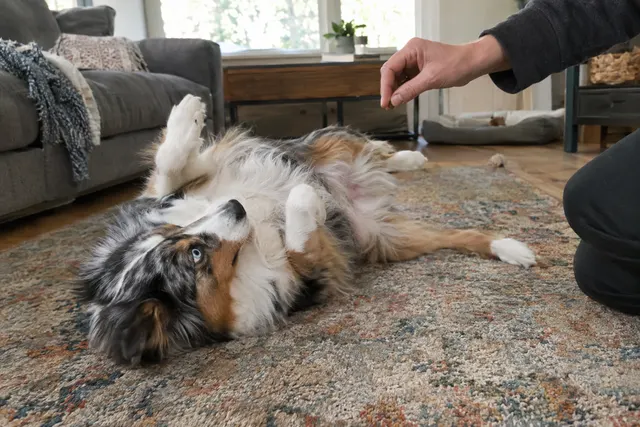
| If your dog lies down, then rolls onto its back | Many dogs roll over to ask for a belly rub. Feed quickly, at the paws, before the roll. If the roll comes with lip licking or looking away, your dog may be uneasy, so slow down and keep sessions short. |
| If your dog lies down at home but not outside | Outdoor ground can be wet or cold, and lying down can feel exposed to a nervous dog. Bring a mat, start somewhere quiet, and accept a sit if your dog seems worried. |
| If your dog lies down only when you bend over | Your posture has become part of the cue. Fade it in stages: signal while kneeling, then crouching, then bending a little, then standing up straight. |
By age
- Puppy (8 to 16 weeks)
- Train down when your puppy is sleepy, such as just before a nap. Sessions of 1 to 3 minutes. Puppies often lie down on their own, so capture those.
- Adolescent (about 6 to 18 months)
- Down in public is hard at this age, especially near other dogs. Keep most practice at home and on a mat, and pay well.
- Adult or rescue
- A dog new to your home may not want to lie down in front of you yet. Don't push it. Capture downs on its bed for the first weeks.
- Senior
- Lying down and getting up again can hurt stiff joints. Use a thick mat, accept a slower down, and do fewer reps in a row. Ask your vet about pain if the down has changed.
What to work on next
When your dog lies down on the word in a few places, add time: feed one treat every few seconds while it stays down, then release. That's a down-stay, and the stay guide covers how to build time, distance and distractions. Roll over also starts from a down, so it's a good next trick.
How Sit AI helps
Sit AI coaches sit today, and down is next on the way. You can already use it for the sit that every down starts from: it watches each rep, tells you when to treat, and tracks how reliable the sit is. A dog with a solid sit learns down faster.
When to get help
See your vet if your dog used to lie down easily and now refuses, lies down slowly with a groan, or gets up stiffly. Pain is a common reason dogs avoid this position. If your dog seems afraid to lie down near people or other dogs, or growls when you lean over it, a certified trainer or veterinary behaviorist can help you work on it safely.
FAQ
Is it "lay down" or "lie down"?
In grammar, a dog lies down. "Lay" needs an object. Your dog doesn't care. Pick the word you'll actually say, usually "Down", and use it only for this behavior, never for getting off furniture.
How long does it take to teach a dog to lie down?
Most dogs follow the lure into a down within 2 to 4 sessions. A down on the word alone at home usually takes 2 to 3 weeks of short daily practice. Down in busy places takes longer, because lying down feels more exposed there.
Why won't my dog lie down?
Common reasons are a hard or cold floor, too much energy, a lure that moves forward, or discomfort. Some dogs also feel unsafe lying down in new places. Try a mat and train after exercise. If the refusal is new, see your vet.
Should I teach sit before down?
It helps. Luring a down from a sit is easier, because your dog is already halfway there. Dogs can also learn down from a stand or by capturing, but most beginners find the sit-first route faster.